Repair in Sleepy Hollow and nearby villages
Drywall Hole Patching in Sleepy Hollow, NY
Drywall hole patching in Sleepy Hollow runs from a picture-hook pinhole to a gap where a return vent once sat. Diameter picks the technique, and the technique sets most of the price. A dime-sized hole is often yours to fix with a putty knife. A fist-sized one is not.
Hole size sets the whole approach.
| Hole | Usual fix | Worth a quote? |
|---|---|---|
| Nail or anchor hole | Spackle, sand, paint | Only alongside a bigger list |
| Up to about 4 inches | Peel-and-stick mesh or a butterfly patch, two or three coats | If you want it to blend under paint |
| 4 to 8 inches | Squared opening, wood cleats, new board, tape and coats | Yes |
| Larger, or at a corner | Cut back to studs, new section, corner bead where needed | Yes |
A proper patch is built in layers.
The drawing shows those layers in a mid-sized patch. Cleats behind the opening give the insert something to screw into. Tape spans the joints around it. Every coat reaches farther than the coat under it, so the repair tapers into the old surface rather than bulging off it.
Texture is where patches give themselves away.
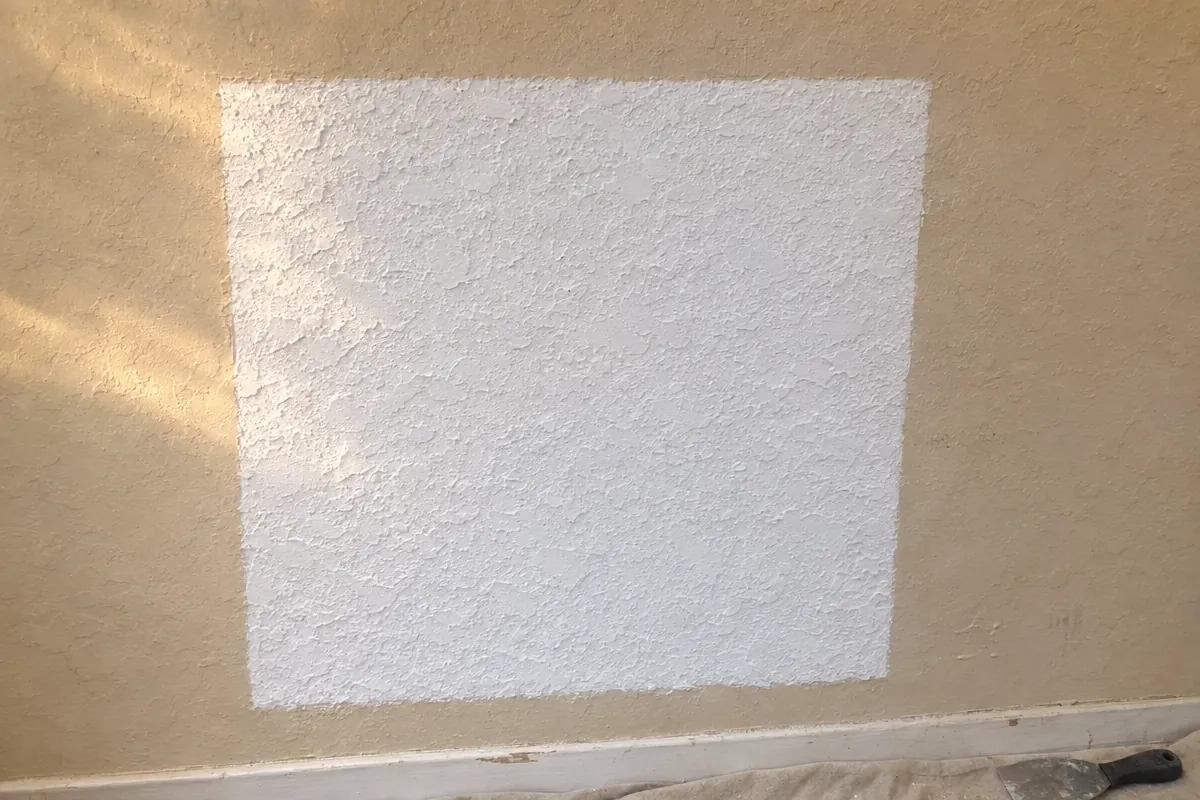
A slick patch on a textured wall gives a repair away more than anything else. The pictured step prevents it: new texture sprayed or knocked down over the patch to mirror the wall, ahead of primer and paint. Orange peel, knockdown and light skip-trowel are all reproducible; the test is sighting along the surface with a lamp beside it.
Older houses in the village, such as the Beekman Avenue homes from the industrial boom, generally have smooth plaster rather than textured gypsum, so the job there is a flat skim tapered wide, and a hole in plaster often needs its lath steadied first. Newer construction like Edge-on-Hudson is gypsum board throughout, and any texture has to be reproduced.
Published ranges, for a sense of size.
This Old House, summarizing national figures, puts patching a small hole of up to three or four inches at about $60 to $200, with bigger holes generally starting near $100. It also lists labor at $60 to $100 an hour, or, priced by area, from $50 to $80 per sq ft. They are countrywide averages, not quotes for this village. Several holes in one room cost less apiece than the same holes scattered through the house, and paint in the price adds to it.
Move-outs and room makeovers add up.
Moving day is when holes get tallied: anchors from shelving and a mounted television, a string of picture hooks, the round dent a swinging knob leaves. Individually each is minor. Listed together they make one sensible job, and one price for the lot keeps the total down.
Patching answers worth knowing first.
- Should I bother calling about a single small hole?
- Honestly, often not by itself. A nail or anchor hole is a spackle job. It becomes worth pricing when there are several, when one spans more than a palm, or when you want the spot textured and painted to match.
- When can a patched spot be painted?
- Once the last skim is dry and sealed with primer. With fast-setting compound in normal room conditions that can be the next day; in a damp basement or with ready-mix it takes longer. Ask which compound is planned.
- Will paint hide where the hole was?
- It is far less prone to show if it is primed first and the texture is reproduced. Sheen matters too: touching up satin with flat leaves a dull square. Rolling the wall corner to corner is the surest blend.
Big hole or small, the price comes first.
Count the holes, compare each to a coin or a hand, and note any texture. Someone who patches walls near here can size the job from that.
Whoever would do the repair phones you first to go over it and give you a figure.